
Low-Level Conduits – Rehab or Replace?
URS Corp., July, 2013
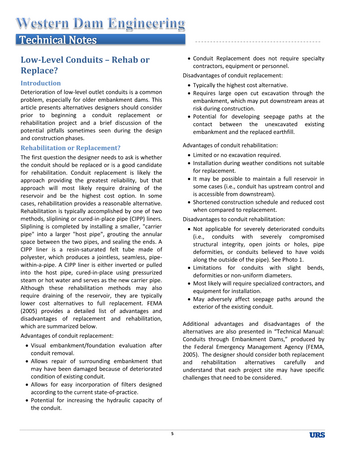
“Low‑Level Conduits – Rehab or Replace?” addresses the common problem of deterioration of low‑level outlet conduits in embankment dams, particularly older structures, and discusses the key considerations involved in selecting between conduit replacement and in‑situ rehabilitation. Because deterioration of outlet conduits can create serious dam safety concerns, including internal erosion and loss of controlled reservoir releases, the article emphasizes the need for careful evaluation before initiating corrective actions.
The article compares full conduit replacement with rehabilitation alternatives, noting that replacement generally provides the highest level of long‑term reliability and allows full inspection and repair of embankment and foundation materials. Replacement also facilitates installation of modern filter systems and may allow for increased hydraulic capacity. However, this option typically requires reservoir drawdown, large open‑cut excavation through the embankment, higher construction costs, and increased construction risk.
Rehabilitation alternatives, most commonly sliplining and cured‑in‑place pipe (CIPP) lining, are presented as viable lower‑cost options when the existing conduit has sufficient structural integrity. Sliplining involves installing a new carrier pipe, typically HDPE or coated steel, inside the existing host pipe and grouting the annular space between them. CIPP uses a resin saturated liner that is installed and cured inside the host pipe to create a new jointless conduit. These methods can shorten construction schedules and, in some cases, allow the reservoir to remain in service, but they are not suitable for severely deteriorated conduits or conduits with significant deformation, joint separation, or external voids.
The article outlines critical design considerations for rehabilitation projects, beginning with thorough cleaning and inspection of the existing conduit, either by direct entry or remote inspection. Key factors affecting the selection and design of a carrier pipe include hydraulic capacity, clearance within the host pipe, internal and external loading conditions, and anticipated service life. The article notes that reduced internal diameter does not necessarily reduce hydraulic capacity, due to improved hydraulic efficiency of new liners.
Potential effects on seepage paths are highlighted as an important consideration, as sealing a deteriorated conduit may raise phreatic levels previously relieved by leakage through the pipe. To mitigate this risk, the article recommends incorporating a downstream filter diaphragm where appropriate. Additional design topics addressed include thermal expansion, joint fabrication and testing, flotation control during grouting, inlet and outlet structure modifications, and proper grouting techniques to eliminate voids in the annular space.
The article stresses the importance of experienced contractors and oversight during critical construction activities, such as liner installation and annular grouting, where errors may be impossible to correct once work has progressed. Preconstruction coordination and real‑time decision‑making during execution are identified as key factors for project success.
The article concludes by emphasizing that conduit rehabilitation projects must be approached on a case‑by‑case basis. Severely deteriorated conduits or those suspected of contributing to internal erosion should generally be replaced, while sliplining or CIPP may be appropriate for conduits in fair to good condition. Careful evaluation of site‑specific conditions, materials, and construction risks is essential to selecting the most appropriate solution.
This article was published in Vol. 1, Iss. 1 (March 2013) of Western Dam Engineering News and discusses alternatives for rehabilitation or replacement of low‑level outlet conduits in embankment dams, including sliplining and cured‑in‑place pipe methods. Western Dam Engineering News is a collaborative effort between the States of Colorado, Montana, New Mexico, and Wyoming and is funded by the FEMA National Dam Safety Act Assistance to States grant program. Special thanks to URS Corporation in Denver, Colorado for authoring the article.
Revision ID: 8333
Revision Date: 02/02/2026