
When it Rains Does it Pour? Design Precipitation Depths for Dam Safety
URS Corp., November, 2013
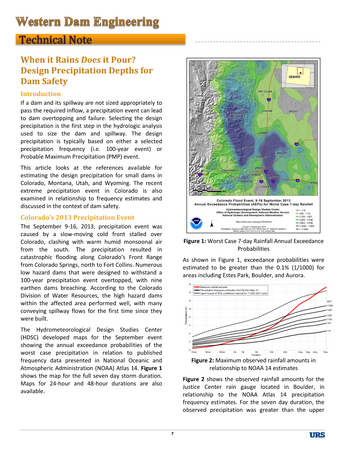
When It Rains…Does It Pour? Design Precipitation Depths for Dam Safety” discusses the critical role of selecting appropriate design precipitation in the hydrologic analysis used to size dams and spillways. If a dam and its spillway are not designed to safely pass the required inflow, extreme precipitation events can lead to overtopping and potential dam failure. The article focuses on precipitation frequency events and Probable Maximum Precipitation (PMP) as the two primary bases for design precipitation selection, with emphasis on small dams in Colorado, Montana, Utah, and Wyoming.
The article uses the September 9–16, 2013 Colorado Front Range precipitation event as a case study to illustrate the consequences of underestimating design precipitation. During this prolonged, high-intensity storm, numerous low-hazard dams overtopped and nine earthen dams breached, while high-hazard dams generally performed as intended. Analysis by the Hydrometeorological Design Studies Center showed that observed rainfall in parts of Colorado exceeded even the upper confidence limits of 1,000-year precipitation estimates, reinforcing the importance of appropriate hazard classification and conservative hydrologic design for dams.
State-specific criteria for design precipitation are summarized for Colorado, Utah, Montana, and Wyoming. In all four states, the required design precipitation is tied to dam height, storage capacity, and hazard classification, with higher hazard dams requiring substantially more conservative design floods, often based on PMP. The article emphasizes that while state regulations define minimum criteria, the acceptable methods for meeting those criteria may vary and should be coordinated with the applicable dam safety regulatory agency.
The article reviews available sources for estimating precipitation frequency events, including NOAA Atlas 14 and the earlier NOAA Atlas 2. As of the time of publication, NOAA Atlas 14 had been completed for Colorado and Utah, while Montana and Wyoming continued to rely on NOAA Atlas 2, supplemented in Montana by USGS regional precipitation studies. NOAA Atlas 14 provides updated precipitation depth-frequency relationships based on longer periods of record, improved statistical methods, and denser rain gauge networks. The article highlights NOAA’s Precipitation Frequency Data Server as a practical tool for obtaining precipitation frequency estimates, confidence intervals, and supporting graphical information.
For PMP estimation, the article describes the use of NOAA Hydrometeorological Reports (HMRs), which provide methods for estimating the theoretically maximum possible precipitation for specific durations and areas. The applicable HMRs depend on the geographic location relative to the Continental Divide. Both local (short-duration) and general (long-duration) storms must be evaluated to determine the controlling design condition. While site-specific extreme precipitation analyses are an alternative, the article notes that such studies are typically complex and not readily feasible for most small dam owners. The article concludes by reinforcing that selection of design precipitation is a foundational step in dam hydrologic design and that rare, extreme precipitation events do occur. The 2013 Colorado floods serve as a reminder that conservative, hazard-appropriate design precipitation criteria are essential for minimizing the risk of dam overtopping and failure.
This article was published in Vol. 1, Iss. 3 (November 2013) of Western Dam Engineering News and addresses the selection of design precipitation depths for dam safety, with particular emphasis on precipitation frequency events, Probable Maximum Precipitation, and state-specific regulatory requirements. Western Dam Engineering News is a collaborative effort between the States of Colorado, Montana, New Mexico, and Wyoming and is funded by the FEMA National Dam Safety Act Assistance to States grant program. Special thanks to URS Corporation in Denver, Colorado for authoring the article.
Revision ID: 8329
Revision Date: 02/02/2026